


Any person between the age of 45 and 74 should do an at-home test every 2 years.
If you’re at higher risk (medical or family history), see a clinician to have a referral for a colonoscopy.
Regular check-ups ensure you do not develop colon cancer.
All tests are FREE under OHIP.
When colorectal cancer is caught early enough through screening, someone with the disease has a 9 out of 10 chance of being cured.
The fecal immunochemical test (FIT) is a screening test for people at average risk of getting colorectal cancer.
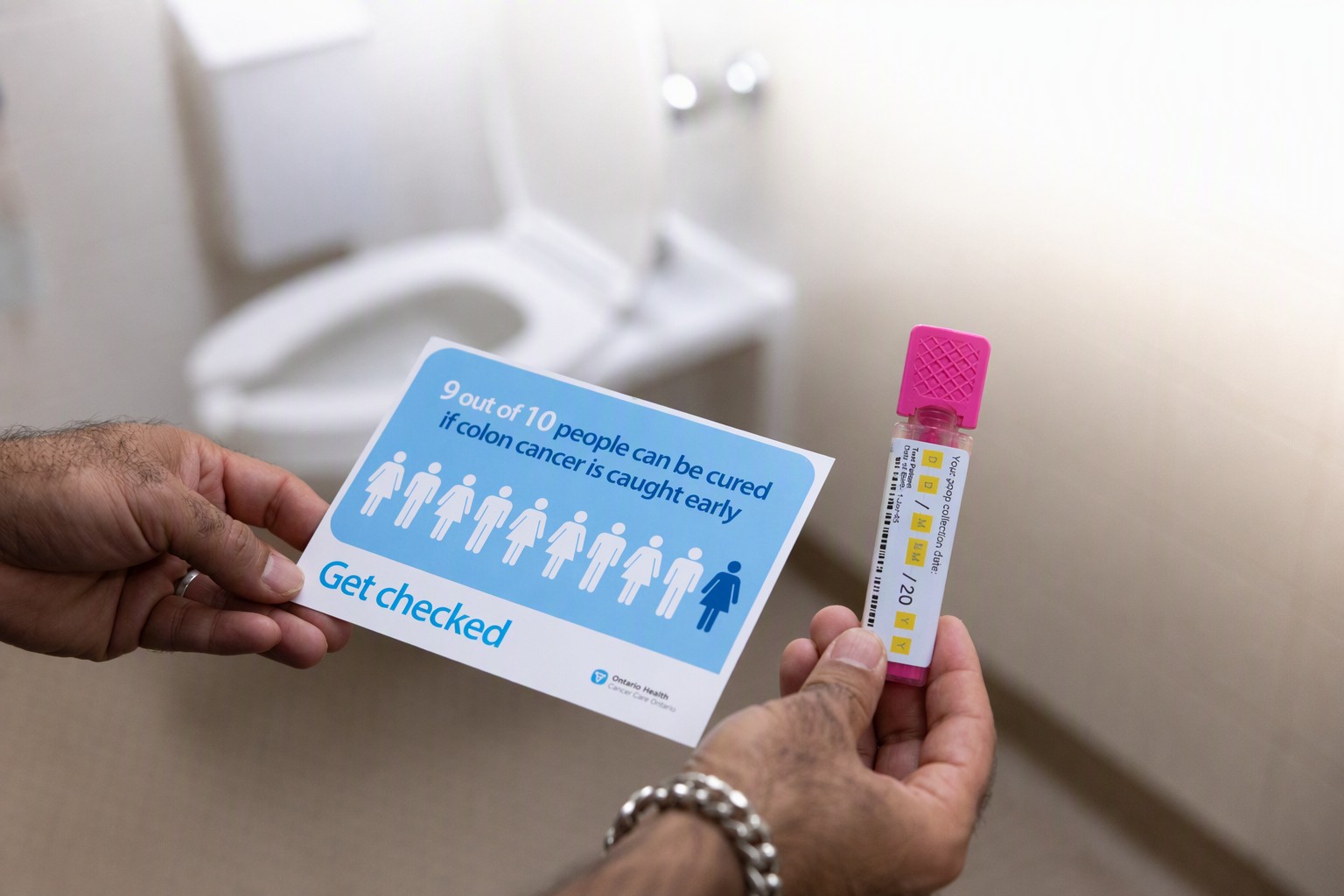
Cancer screening is testing done on people who are at risk of getting cancer, but who have no symptoms and generally feel fine. Screening increases the chance of finding cancer early when it is more likely to be cured. If you have colorectal cancer and do not get screened, you may miss the chance for early and more effective treatment.
The kind of screening test you get depends on whether you are at average risk of getting colorectal cancer or at increased risk of getting colorectal cancer.
Cancer screening is testing done on people who are at risk of getting cancer, but who have no symptoms and generally feel fine.
Your age and family history help your doctor or nurse practitioner figure out when you should get screened for colorectal cancer and what screening test is best for you.
| Your Family History of Colon Cancer | When to Start Screening | Type of Screening | How often to Screen |
|---|---|---|---|
| Average Risk | |||
|
Age 45 |
Fecal immunochemical test (FIT) Flexible Sigmoidoscopy |
Every 2 years Every 10 years |
| Increased Risk | |||
|
Starting at age 40, or 10 years earlier than the youngest age a relative was diagnosed (whichever comes first) | Colonoscopy | Every 5 years |
Fecal immunochemical test (FIT) is a safe and painless at-home cancer screening test.
FIT checks someone’s stool (poop) for tiny amounts of blood, which could be caused by colorectal cancer or some pre-cancerous polyps (abnormal growths in the colon or rectum that can turn into cancer over time).
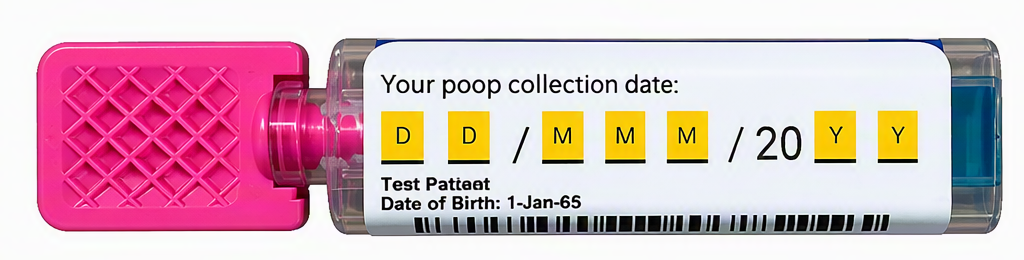
Here is what you need to know about FIT:
If your test result is abnormal, it does not necessarily mean that you have colorectal cancer or polyps that could become cancer, but it does mean that additional testing is needed. ColonCancerCheck recommends that people with an abnormal result have a colonoscopy within 8 weeks.
If your test result is normal, you should get screened in 2 years using FIT. It is important to keep getting screened with FIT every 2 years until age 74.
If In-Common Laboratories cannot get a result from your test, you will need to repeat it.
A colonoscopy is a test done by a specialist at a hospital or clinic.
Your family doctor or nurse practitioner will send you for the test. If you think you may be at increased risk of getting colorectal cancer, be sure to speak with your family doctor or nurse practitioner.
A colonoscopy allows a doctor to look at the entire colon using a long, flexible tube with a tiny camera on the end. During a colonoscopy, the doctor can also take biopsies (samples of tissue) or remove polyps that can become cancer over time (called pre-cancerous polyps).
A colonoscopy is not recommended to screen people who are at average risk of getting colorectal cancer. However, a colonoscopy is recommended to screen people who are at an increased risk of getting the disease. A colonoscopy can also be used to test people who have symptoms such as rectal bleeding or diarrhea.
It is very important that people with an abnormal FIT result have a colonoscopy within 8 weeks.
ColonCancerCheck no longer recommends screening with the guaiac fecal occult blood test (gFOBT), which is now replaced by FIT. FIT is a better test and is easier to use.
The following tests are not recommended for average risk and increased risk screening because there is not enough research showing that they are a good way to check for colorectal cancer:
The fecal immunochemical test (FIT) is an at-home screening test. To get your free FIT, talk with your family doctor or nurse practitioner.
If you do not have a family doctor or nurse practitioner, you can get a FIT by calling Health811 at 811 (TTY: 1.866.797.0007) or visiting your nearest walk-in clinic.
If you live on a First Nation community, contact your health centre or nursing station for more information.
Once a FIT has been ordered for you, In-Common Laboratories will mail a FIT package to your Ontario mailing address of choice. For more information on how to do your FIT, see the FIT Instructions page.
If you have any problems with your FIT package, call In-Common Laboratories at 1-833-348-7667.
How to Get Screened
Make an appointment with your doctor or nurse practitioner to order a FIT test or discuss a colonoscopy.
If you do not have a doctor or nurse practitioner, you can get a FIT test by calling Health811 at 811 (TTY: 1.866.797.0007).