


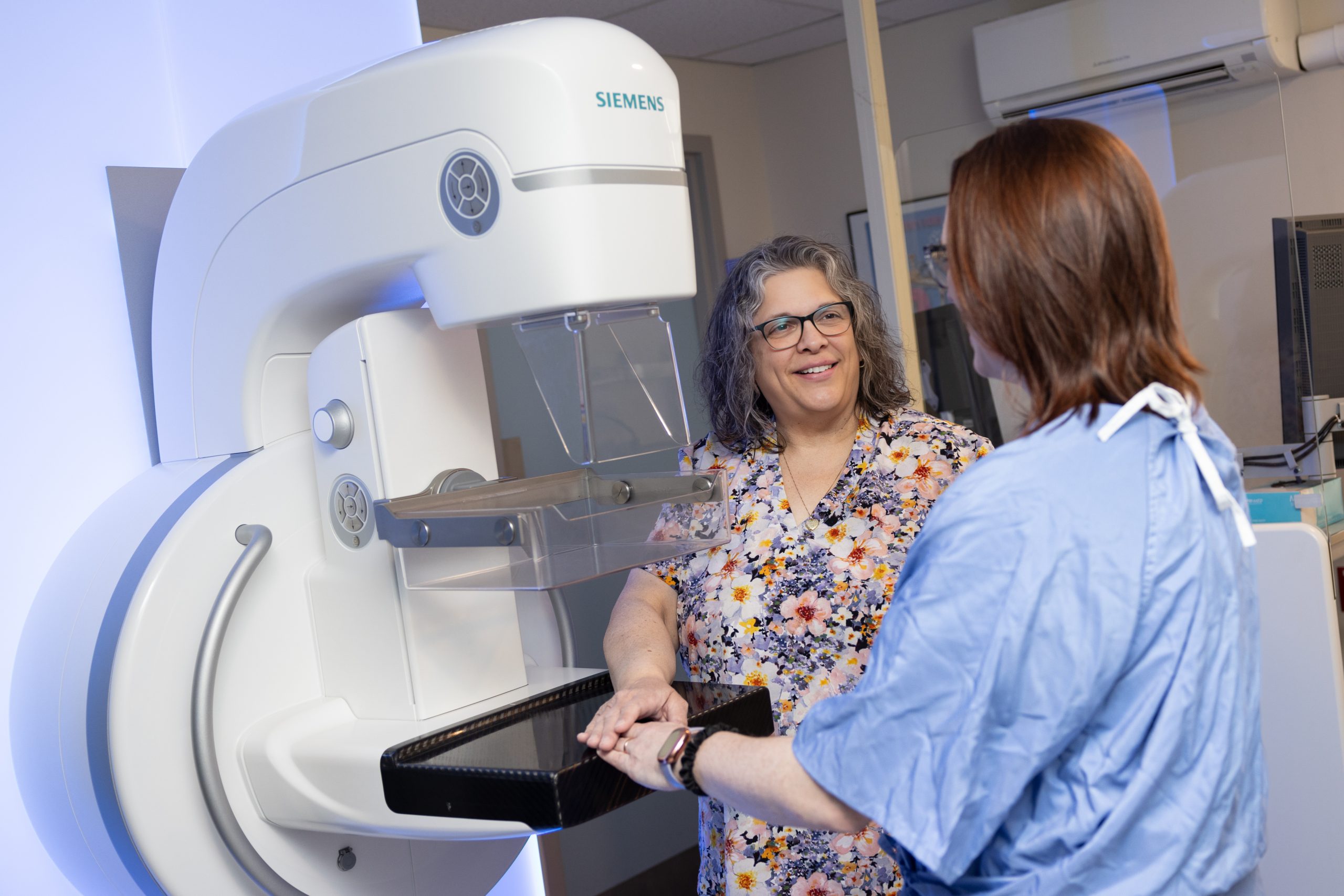
Regular breast cancer screening can find breast cancers when they are small and less likely to have spread. This can make treatment of the breast cancer more successful.
Cancer screening is testing done on people who may be at risk of getting cancer, but who have no symptoms and generally feel fine. Screening can find breast cancers when they are small, less likely to have spread, and more likely to be treated successfully. People ages 40 to 74 have a lower risk of dying from breast cancer when they are screened regularly with mammograms.
The OBSP encourages people ages 40 to 49 to make an informed decision about whether breast cancer screening is right for them. Please discuss screening with your primary care provider, a Health811 navigator or, in certain communities, a prevention specialist.

Screening mammography can find breast cancers when they are small, less likely to have spread and more likely to be treated successfully. Your age and family medical history help determine when you should get screened:
If you are age 30 to 69 and meet any of the following requirements, talk to your doctor or nurse practitioner about referral to the High Risk Ontario Breast Screening Program:
For every 200 people screened in the Ontario Breast Screening Program, about 18 are referred for further tests and 1 will have breast cancer.
Mammography remains the best screening test for most people. A screening mammogram takes an X-ray picture of the breast and can find breast cancers when they are small, less likely to have spread and more likely to be treated successfully.
Mammograms are considered safe and use a low dose of radiation. The benefits of screening and finding cancer early are more important than any potential harm from the X-ray. Most people will have normal mammogram results.
In order to do a mammogram, you will need to undress from the waist up. You will place your breast onto the mammography unit and a compression paddle will then come in contact with the breast, gently spreading the breast tissue out. This pressure lasts for a few seconds while the x-ray is taken and then releases automatically. Although this pressure can be uncomfortable, it does not harm the breast and helps to produce a much better picture for the radiologist. Usually four pictures (two of each breast) are taken. Please allow 15 minutes for the exam.
The Ontario Breast Screening Program directly notifies participants (with or without a primary care provider) of their normal results by mail. The letter will also tell participants when to get screened again. The screening site also sends normal screening results to a screening participant’s primary care provider. In the event of an abnormal screening result, their screening site will notify their primary care provider and may help to schedule a timely follow-up appointment. A participant with an abnormal mammogram who does not have a primary care provider will be assigned to a doctor or nurse practitioner by their screening site to follow them to diagnosis. If the participant does have breast cancer, they will be referred to a specialist for further care and management.
Mammograms are the best way to find breast cancer early. But they are not perfect tests. Mammograms may miss some breast cancers. Also, some cancers develop in the time between screens. However, many studies have shown that regular mammograms reduce the risk of dying from breast cancer.
Some breast cancers that are diagnosed through screening may never cause symptoms in a person during their lifetime (i.e., over-diagnosis). Therefore, some people may have surgery or treatment for a breast cancer that would not have become life threatening.
Not all cancers found at screening can be treated successfully.
Ontarians ages 40 to 74 do not need a healthcare provider’s referral to book a mammogram through the OBSP.
To discuss this, make an appointment with your doctor or nurse practitioner. If you do not have a doctor or nurse practitioner, you can see the map below for your nearest clinic to have it ordered (if you do not fall within the ages of 40-74, who can access the screening test directly).
Below is a list of the clinics in our region where you can get a mammogram.
| CITY/ TOWN | OBSP SITE | ADDRESS | TELEPHONE | ACCESSIBILITY | |
| Wheelchair accessible facility | Accommodation available** | ||||
| Cambridge | Cambridge Medical Imaging | 103-614 Coronation Blvd. | (519) 740-3736 | Yes | No |
| Cambridge | Cambridge Memorial Hospital | 700 Coronation Blvd. | (519) 740-4999 | Yes | Yes |
| Cambridge | True North Imaging - Cambridge | 350 Conestoga Blvd., Unit B9 | (519) 742-7599 | Yes | Yes |
| Erin | Erin Diagnostic Imaging | 6 Thompson Crescent | (519) 833-0000 | Yes | No |
| Fergus | Groves Memorial Community Hospital | 131 Frederick Campbell St. | (519) 843-2010 ext. 3403 | Yes | Yes |
| Guelph | Guelph General Hospital | 115 Delhi St. | (519) 837-6440 ext. 2450 | Yes | Yes |
| Guelph | Guelph Medical Imaging | 54 Cardigan St. | (226) 314-0778 | Yes | Yes |
| Kitchener | True North Imaging - Kitchener | B102-751 Victoria St. S. | (519) 742-7599 | Yes | Yes |
| Kitchener | Waterloo Wellington Breast Centre - WRHN @ Chicopee | 3570 King St. | (519) 749-4300 ext. 4270 | Yes | Yes |
| New Hamburg | UltraScan Medical Diagnostic Imaging | 338 Waterloo St. | (519) 390-7226 | Yes | Yes |
| Waterloo | True North Imaging - Boardwalk | 430 The Boardwalk Suite 108 | (519) 742-7599 | Yes | Yes |
| Waterloo | True North Imaging - Waterloo | 65 University Ave. | (519) 742-7599 | Yes | Yes |
| Waterloo | Sure Care Diagnostics | 380 King St. N. | (519) 206-7777 | Yes | No |
**Site has or is able to accommodate a chair or wheelchair with removable or lift-up armrests.
View wait times at your local breast cancer screening centre.
The Mobility Clinic offers breast (and cervical) cancer screening for people with physical disabilities or accessibility issues. A referral is needed for the Mobility Clinic.