

Stopping smoking is one of the best things you can do to help your cancer treatment work better and reduce the side effects of treatment.
Being smoke-free also reduces the chance of your cancer coming back, or getting another kind of cancer.
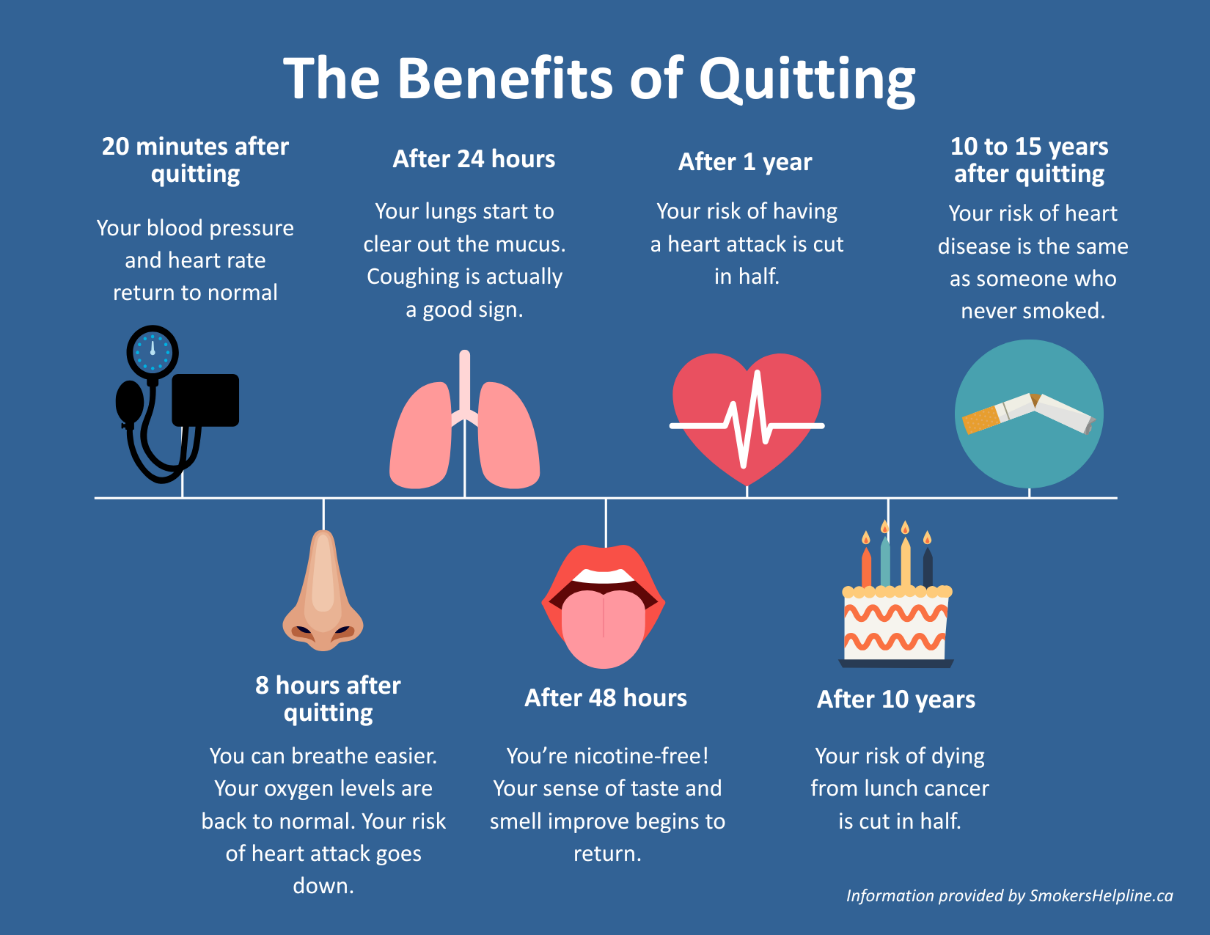
When you smoke, your oxygen level drops, making it harder for radiation to do its job. Radiation therapy works best when the amount of oxygen in your body is normal.
If you can’t stop smoking, avoid smoking before and after your radiation therapy appointment.
Cigarette smoke has chemicals that can lower the amount of some chemotherapy drugs in your blood, making them less effective. Chemotherapy drugs work better in people who don’t smoke.
Stopping smoking, or reducing the number of cigarettes smoked, can make surgery safer and help you recover faster.
If possible, try to stop at least 4 weeks before your surgery. But stopping at any time before surgery is helpful.
People who don’t smoke:
Using both counselling and medication can triple your chance of success. Your healthcare providers can help you decide which ways to stop may be best for you. Start by talking to your:
A counsellor can help you create a quit plan that works for you and can teach you how to manage your cravings. You can meet with a quit smoking counsellor in-person, by phone or online.
The cost of nicotine replacement therapy (NRT) and prescription medications may be covered by some private insurance plans and public benefit programs (i.e., the Ontario Drug Benefit program and the Non-Insured Health Benefits program for First Nations and Inuit). You may need to pay out-of-pocket depending on your eligibility for public coverage and/or access to private insurance.
NRT comes in many forms including patches, gum, lozenges, mouth spray and inhalers. Using NRT can double your chance of quitting by reducing nicotine cravings and withdrawal symptoms. Combining the nicotine patch with another NRT product (gum, lozenge, spray or inhaler) can increase your chance of quitting compared with using a single product.
NRT is sold in pharmacies and some stores. You do not need a prescription. Free NRT is available with some of the stop smoking programs available to cancer patients, talk to your nursing team for more information.
Two prescription drugs that do not contain nicotine are available to help reduce cravings and prevent relapse are Varenicline and Bupropion. These drugs require a prescription from a doctor, nurse practitioner or pharmacist. You can access these prescription medications by enrolling in one of the stop smoking programs available to cancer patients by talking to your nursing team.
Free NRT, personalized support by local providers, access to prescription medications.
Ask your cancer care nursing team for a referral to one of the available stop smoking programs free for cancer patients.
Free NRT shipped to your home.
24/7 access to personalized support, education resources and tools
Text “iQuit” to 123456
Provides culturally relevant, accessible and targeted commercial tobacco and vaping cessation services for First Nation, Inuit, Métis and urban Indigenous communities.
Text CHANGE to 123456
Find local stop smoking programs in your community that can help you find free or low-cost medications.
Quitting smoking is a powerful step toward better health, and while it can be challenging, every effort you make counts. It’s normal to face setbacks along the way. What matters most is that you keep moving forward. Be kind to yourself and stay committed.
You can learn how to avoid tobacco by:
This information is provided by Ontario Health in collaboration with Ontario’s Regional Cancer Programs and the Canadian Cancer Society Smokers Helpline.
Hi, I’m Dr. Mike Evans and I think quitting smoking is a journey. For some, it’s a short journey full of resilience. Uh but I think for most it’s a long journey, a long affair if you will, of quitting and relapse. A complicated relationship that can have as much to do with a person’s relationship with themselves as with the cigarettes.
What starts as a pleasant sensation, opportunity to rebel or even to belong is replaced by less pleasure and a feeling of being trapped. A daily or hourly ride of nicotine withdrawal and then another cigarette which brings relief. Most teens who smoke think they will quit in their 20s and actually don’t till their 40s.
Stopping smoking is about making a change. And that is something we’re not too good at. When I think of change, I think of two concepts: where you are at and the mechanics of how we change. So, we should start where you are at.
When I started medical school, I thought I could take somebody who smoked and convert them into a non-smoker in one fell swoop. Now, I see it differently. I focus on where the person is at. You may be in what we call pre-contemplation where you’re not really even thinking about change. Approximately 75% of smokers want to quit, but 25% are not interested.
Maybe you’re at the contemplation stage, thinking about it, but not quite ready to act. Next is preparation. This is critical with smoking, especially in the likely event that you’ve tried to quit before. What has worked in the past and what hasn’t? What caused the relapse?
Maybe you’re at the action stage. This is when you’re ready to make your move. There’s never a perfect time to quit and at one point you just have to jump. I’ll tell my patients, hey, it’s going to be a challenge now and it’s going to be a challenge in 5 years, so why not do it now?
And finally, there’s the maintenance stage where you become a non-smoker and are trying to stay that way. When we make changes, it’s critical to stop and think, how important is this change to me and how confident am I in making this change? What we call your self-efficacy. Your job is to be honest. My job is to see if I can move your scores towards 10.
The parts of change
The second concept is about the different parts of change. So there’s the what — what are we changing with smoking? I suppose it is straightforward stopping. But if you think about it, you might be changing lots of things.
I think it is like a relationship breakup. You start by just keeping things simple and low risk. You might break up your routine a little bit, avoid certain places, maybe use that juicer every morning to distract yourself, but you will need to change more than your smoking to stop your smoking.
The why
The next is the why — why change. I feel like I could do a 10-minute video just on all the medical reasons why not to smoke. And they are legion, but I’m going to spare you. Partly because you already know, partly because you don’t need any more guilt, and partly because in clinic, I actually spend more time asking people what they like about smoking, which sounds funny, but I think we have to recognize there are positives or at least perceived positives.
And I think it’s important to reframe these perceptions if we are to make a change. So, let’s run through a few of the common ones. Cigarettes are my friend. They distress me. They relax me. I’m not going to deny that you may feel a sense of relief and satisfaction when you have a cigarette. But I see it a bit differently.
You have a nicotine addiction. The nicotine and tobacco is highly addictive. Within a few seconds of inhaling, it travels to your brain, causing you to have a temporary high. Over time, your brain changes, causing you to smoke more to get the same effect.
We rate your addiction to nicotine with a few simple questions. Do you smoke more than 15 cigarettes a day or smoke within 30 minutes of getting up in the morning? Do you find it difficult to go more than 4 hours without a smoke? The power of nicotine comes from the repeated small doses you give yourself when you smoke. It may seem innocent at first, but if you take 15 puffs from a cigarette and smoke, say 20 cigarettes a day, that’s 300 drug doses a day.
You think smoking relieves your stress or is satisfying, but it actually isn’t. The cigarette is just making your nicotine addiction go away. Smoking doesn’t make your concentration better. It just calms your nicotine receptors’ cry for more. Smoking makes your heartbeat faster, increases blood pressure and breathing. These are all symptoms of stress, not stress reduction. Let me repeat that. The cigarette just reduces your nicotine stress, not your real stress.
Triggers
I’ve got a lot of trigger times. Coffee, sex, meals, certain people, break times, telephone calls, the car. There are a lot of triggers you’re going to have to prepare for. You got to change your coffee routine. Plan something to do right after meals. Throw out your car ashtray. I have no advice on sex, but make a plan for breaks or the telephone with lots of distractions.
Know that when you have a hunger or caffeine or other types of pangs, you also have a nicotine pang that needs to be satisfied. You have associated these, but they’re actually separate. Alcohol and parties double the risk as you have the association, plus you’re imbibing something that tends to lower your resolve.
I will gain weight
I want something in my hand. Yes, you are making maybe 300 hand motions a day. You may need to replace this by chewing gum or chewing on a straw or a cinnamon stick or playing on your cell phone to keep your hands busy to replace this daily habit.
I will gain weight. Yes, you might. But I think this is actually more marketing than reality. What I call the Virginia Slims effect. On average, people who quit gain about 2.5 kg or 5 pounds. So, two thoughts on this.
Firstly, if this is a concern for you, you might want to focus on strategies that affect calories in and calories out, such as your new daily routines might focus on walking, a special emphasis on being mindful of emotional eating, or that your hand-mouth routine includes carrots or celery sticks.
My second point is about perspective. A possible 5 pounds may be important from a vanity perspective, but from my doctor perspective, the health return is spectacularly higher when you stop smoking.
Remember, we said smoking was a relationship. Part of the healing of stopping a damaging relationship is starting new healthy relationships. So, now is the time to start a deeper relationship with your bicycle or salads or walking or gardening and/or your supportive friends.
How do I change
Next is the how. What are the skills required to change? How do I change with the emphasis on I? So, what works? Well, let’s start with willpower. It’s a strange word. On the one hand, it permeates behavior change and all the interventions we talk about. It’s also a word I don’t love as people see it as black and white.
If a person succeeds, they have willpower and if they fail, they have no willpower. The science of willpower and smoking gives a mixed message. Approximately 5% of smokers who try to quit cold turkey achieve prolonged abstinence for 6 to 12 months with most relapsing in the first 8 days of attempting to quit.
On the other hand, most people who quit do so unassisted. Maybe two-thirds to three-quarters of people do so by themselves. Reconciling these two stats reveal the natural history of smoking cessation — that “failures” are part of this process and can be seen as dress rehearsals for the eventual success.
Another key pearl here is the data which tells us that our perception of the quitting smoking experience is often much darker than reality. In a British study of people who were surveyed about their quit experience, 53% said that it was not at all difficult to stop. 27% said it was fairly difficult and the remainder found it very difficult.
So to summarize, you can do it by yourself and it may be less difficult than you think. On the other hand, it looks like your chances are better if you layer on some other tactics. So if you fail, try again and think about adding another strategy.
Some say there are two types of cigarettes: those that are dealing with your nicotine addiction and those that have become part of a routine. So let’s see what works for both these types of cigarettes.
Treatments
Let’s start with treatments that have not been proven effective and where you may be wasting your money. Now, some of my patients have found they help. And to be honest, if they stop your smoking, I suppose I don’t really care. But under this category, I put laser therapy, acupuncture, and hypnosis. When we compare these treatments to a placebo or just compare them to the quit rates of people on waiting lists, the rates don’t appear to be improved.
Next is medications to help stop smoking. The data shows that medications, especially when combined with behavioral support, can double your chance of success. Many patients are resistant, which I get, but I also see an irony in the fact that people are willing to inhale chemicals much, much worse for them, but they won’t take a medication for a few weeks or months to stop smoking for the rest of their life.
If we use nicotine replacement therapy as an example, it allows people to deal with the addiction of nicotine without having to inhale the other 7,537 chemicals in cigarettes. And that’s what I worry about. People die — two full 747s of people a week in Canada from smoking, not nicotine.
Nicotine replacement therapy comes in multiple forms, and there is usually less nicotine than what you get in a cigarette. You can put on a patch, which is easy and discreet. You can chew gum, although in a different way than you usually chew gum. You can suck on a lozenge or you can use an inhaler.
The patch gives you a nice baseline nicotine level to lower your cravings. The latter three offer the advantage of flexible dosing when you have a nicotine craving and a familiar routine of opening packages and putting something in your mouth.
Important things people need to know
Important things people need to know about nicotine replacement therapy are, firstly, you can design your own nicotine program. You do not need a prescription. Prefer the patch and then the gum or lozenge or inhaler for breakthrough cravings? Great. Maybe you smoke under 10 cigarettes a day and just want to use the gum when you need it. Your pharmacist can really help here.
People get a bit confused with the cost. NRT is generally cheaper than smoking, but you might be buying a month at once. Moneywise, of course, it’s a no-brainer. A pack a day is maybe $3,600 a year. Imagine what you would do with that money. Imagine what you would do with 10 years of that savings.
Secondly, with nicotine replacement, you can stop cold turkey or you can wean down your smoking. Taking nicotine and smoking together does not increase your risk of heart attacks. Smoking does. You probably started smoking gradually and I guess the same can be true of stopping. If you feel you need another month of NRT, then that’s fine.
I’m not going to go into details of pills for smoking cessation, but I will give you a quick overview of the two most known ones. The first is Zyban or Bupropion. It started just as an antidepressant. Then users found their desire for smoking dropped and they were able to quit more easily. Champix or Chantix in the US is Varenicline and it is a newer option that may be even more effective but also has some side effects that may make it not for everyone. You can discuss these options with your doctor or other healthcare providers. The counseling needs to be individualized.
Behavioral interventions
The final approach is the behavioral interventions. I covered some of this ground but I don’t think people realize how many fantastic resources are out there for them. Governments make a lot of money from people who smoke and they funnel it into superb programs.
You want a text message, a supportive email. You want expert counseling, want to be connected with other people going through the same thing or who have just been there. Or maybe you just want to talk to someone. Go online, call the helpline, buy the book, get the message.
In the first months following quitting, I want you to prepare for the roadblocks of risk and stress. So avoid high-risk situations. You know what they are. You might want to tell the people involved in advance. And I want you to focus on stress reduction. Stressful things are going to happen to you, but you create the stress. Tell people, “Hey, I’m quitting smoking this much, so what’s the least stressful strategy that works?”
I also get people to think about the three A’s. Avoid situations you know are stressful for you. Alter expectations. So when you look at your to-do list, be realistic. Manage expectations up front before it’s stressful. And the final is acceptance.
If we use driving as example, traffic jams, bad drivers, and flat tires happen. Take a deep breath. Focus on what you can control and accept what you can’t.
Now, let’s say you quit smoking. That’s excellent. You’ve broken up. So, what now? Well, first of all, you’re great. Secondly, there’s going to be some ups and downs. More ups, especially after you get through the first months. But some of the things to expect with nicotine withdrawal are cravings. And these don’t follow a perfect line.
Headaches, nervousness, irritability, trouble sleeping, and you may want to eat more. So, have some healthy foods ready. And also people tend to have more of a cough as their lungs self-clean.
Finally, the Japanese have a proverb that success is falling down seven times and getting up eight times. If you get derailed, don’t feel guilty. As I said at the beginning, this is a journey. Come back and see us. This is the best thing I can do for you. Don’t learn helplessness. Learn about yourself and get ready for the next round.
And thanks for listening.