


An implanted port (also called a “port” or “port-a-cath”) is a type of central venous catheter. It is used to inject medicines, fluids, or other products directly into your vein as part of your treatment (called intravenous or IV therapy).
Your doctor or nurse may recommend a port for you if:
Some implanted ports can also be used for high speed injection during CT scan or MRI test (special kind of x-ray). These ports are called “power-injectable ports”. Your nurse will let you know if you have a power-injectable port.
Your port can stay in for the whole time you are on IV treatment, as long as it is working well and shows no signs of infection. Your doctor will request to have your port taken out when you don’t need it anymore.
The port is usually placed under your skin about 2 to 3 centimetres below your collar bone. You may feel a round or triangle shaped bump on your skin where the port is.
The middle part of the port (called “septum” or “access site”) is made of a self-sealing rubber that holds the port needle safely in place during treatment.
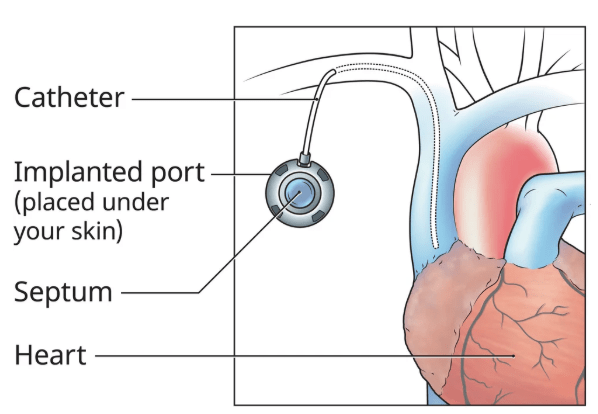
Your port is connected to a thin flexible tube called a catheter. The end of the catheter sits in a large blood vessel leading to your heart.
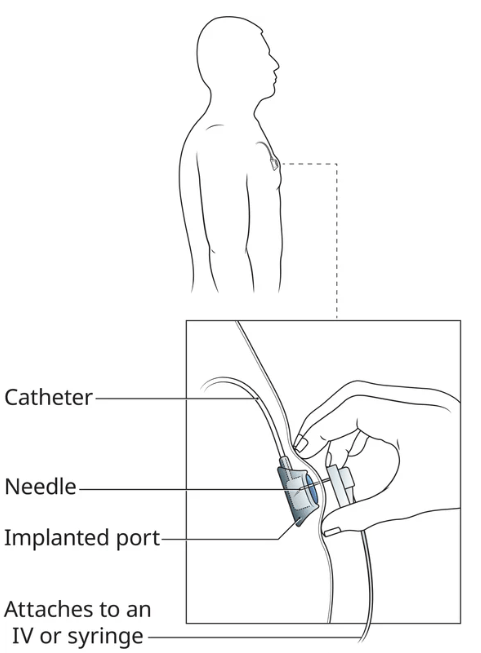
When your port needs to be used, your nurse will insert a special needle into the port septum. This is called “accessing the port”. This needle allows fluid or medicine to flow from your port through the catheter and into your bloodstream.
The port needle must be covered with a sterile dressing and must be changed every 7 days when in use. Your nurse will remove the port needle when your treatment is done.
It’s not safe for you to drive home. Have a family, friend, or taxi drive you home.
Your port will be taken out once you no longer need it for treatments. It is taken out in Interventional Radiology. The port may also be taken out if you get an infection or if it is not working.
Once the port is out, a dressing will be put on to cover the site. The nurse will tell you when to take off the dressing, and when you can shower.
Watch a video about port insertion from University Health Network (UHN) Patient Education.

Your homecare team (Ontario Health atHome) should be able to answer most questions about your port. Contact your homecare coordinator directly.
If you have questions about your cancer care, or side effects from your cancer/treatment, you can call your cancer healthcare team.
WRHN Cancer Centre call centre
8:30 a.m. and 4:00 p.m. Monday to Friday.
519-749-4380
CareChart Digital Health
If you need support outside of the cancer centre’s business hours you will need to contact CareChart Digital Health:
1-877-681-3057
www.carechart.ca


About This Resource
Author: Waterloo Wellington Regional Cancer Program
Revised: March 2026
PEM#: WRHNCC0049
Adapted with permission from “What to expect when getting an implanted port” (2025), UHN Patient Education & Engagement. Use this resource for your information only. It does not replace medical advice from your doctor or other healthcare professionals.
Email: [email protected]
Website: www.cancerwaterloowellington.ca
Treatment
Overview of key safety concerns for patients starting to take oral cancer drugs.
During Treatment
A resource for patients on drugs for bone health, listing common side effects that you should contact your team about.
System Navigation
A guide in the steps to get your prescription drugs for cancer treatment at WRHN CC.