


A Peripherally Inserted Central Catheter (PICC) is a small, flexible tube placed into a vein in your arm. One end of the tube goes inside your body to allow access to a larger vein in your chest. The other end stays on the outside of your body.
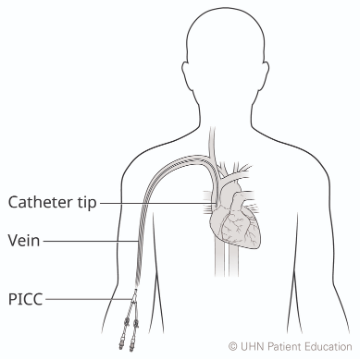
This kind of treatment is called intravenous (IV) therapy. Having a PICC means you don’t have to have a needle put into your arm each time you need IV therapy. Your nurse can access and use your PICC instead.
Your nurse can also use your PICC to collect blood samples and to give you:
As long as it is working well, your PICC can stay in for the whole time you are on treatment.
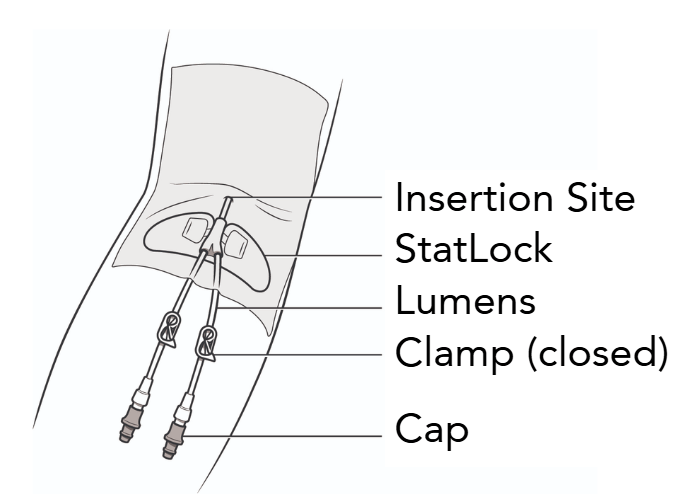
This is the place where the PICC is put in. The exit site must be covered with a bandage to prevent infection.
To stop your PICC from slipping out, we use a special tape called StatLock to hold your PICC firmly in place. The StatLock must be changed when your PICC bandage is changed.
Your PICC may have 1 or 2 tubes that come out of your skin. These tubes are called lumens. Each lumen is a separate tube. Having more than 1 lumen means your nurse can give you different IV treatments at the same time.
A cap closes the end of each lumen opening. The cap is used to:
– Stop blood from coming out of the lumen if the catheter is not clamped.
– Stop germs from entering the catheter.
– Make sure the IV tubing and syringes are safely attached to the lumens.
On the end of each lumen, you will find a clamp. The clamp prevents blood from coming out of the catheter. Make sure the clamp is always closed when the lumen is not in use or when the lumen cap is being changed.
Some PICCs do not have a clamp. They may have a special valve inside the catheter that works like a clamp. Your nurse will let you know if you have this type of catheter.
Your PICC will be put in at the Medical Day Unit.
Your PICC needs to be kept clean to prevent infections and to keep it working well.
A community nurse will help care for your PICC by:
Your homecare team (Ontario Health atHome) should be able to answer most questions about your PICC. Contact your homecare coordinator directly.
If you have questions about your cancer care, or side effects from your cancer/treatment, you can call your cancer healthcare team.
WRHN Cancer Centre call centre:
8:30 a.m. and 4:00 p.m. Monday to Friday.
519-749-4380
If you need support after regular business hours you will need to contact CareChart Digital Health:
1-877-681-3057
www.carechart.ca
About This Resource
Author: Waterloo Wellington Regional Cancer Program
Revised: August 2026
PEM#: WRHNCC0050


Adapted with permission from “Peripherally Inserted Central Catheter (PICC)” (2025), UHN Patient Education & Engagement. Use this resource for your information only. It does not replace medical advice from your doctor or other healthcare professionals.
Email: [email protected]
Website: www.cancerwaterloowellington.ca
Treatment
Overview of key safety concerns for patients starting to take oral cancer drugs.
During Treatment
A resource for patients on drugs for bone health, listing common side effects that you should contact your team about.
System Navigation
A guide in the steps to get your prescription drugs for cancer treatment at WRHN CC.