


Specialized health professionals who can help you manage symptoms and side effects from cancer and treatment.
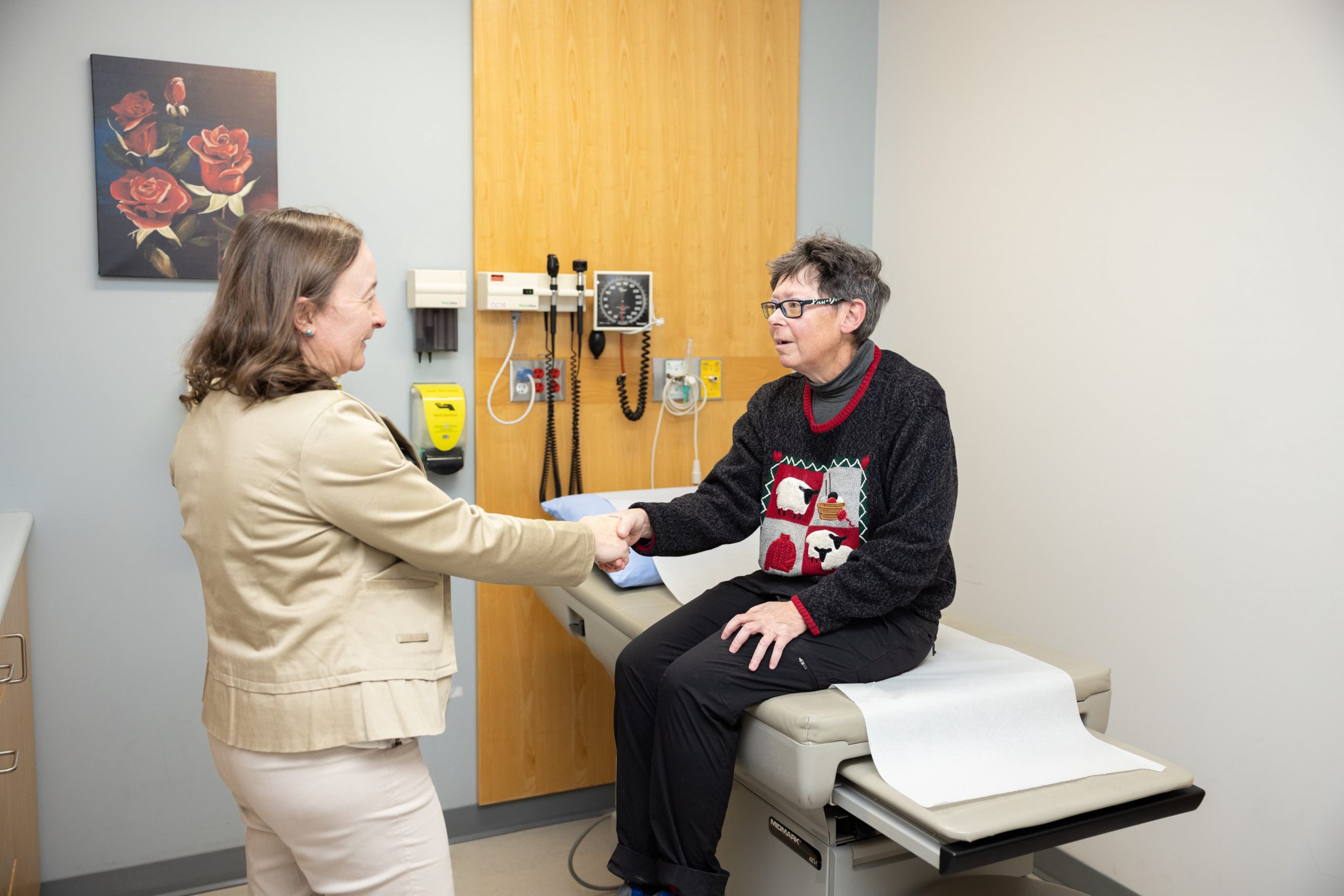
The Pain & Symptom Management (PSM) team at WRHN Cancer Centre can help you to manage pain and/or symptoms from your cancer. They are experts in advanced cancer care, symptom management, and future planning. You can see them before starting, during, or after treatment based on your needs. This team supports patients where the intent of treatment is not to cure the disease, but to manage symptoms and maintain your quality-of-life.
The PSM team provides care to all WWRCP patients including those who are receiving care at one of our regional partner sites. You will need a referral from your Oncologist to access their service.
The Pain & Symptom Management Team can:
This is a service that you may see as an inpatient at WRHN Cancer Centre. An inpatient is someone who has been admitted to the hospital.
This team offers the same services as the Pain & Symptom Management Team, but inside the hospital. They will visit you, or your loved one, while in the hospital. They help to manage your cancer related symptoms, can treat you, and help to put a plan in place for when you go home.
Palliative care is a type of care that offers physical, emotional, social and spiritual support for people with cancer and their families.
Palliative care does not just involve end-of-life care. Palliative care services can start as early as diagnosis, through treatment of your symptoms, to end of life care. It can be used by anyone, at any age, at any stage of their cancer care journey.
Depending on your needs you might have palliative care in an outpatient clinic, in the hospital, in a community clinic, or at home.
Palliative care teams often include:
And your care team might refer you to a:
Palliative Care Doctors are medical specialists who work to improve a patient’s comfort and quality-of-life. Their role is not just about end-of-life care (but that can be part of it). They help patients at any stage of a serious illness. This includes when they are getting cancer treatment.
Are you finished treatment?
Watch video: https://www.youtube.com/watch?v=fY2iE9fTG6U
Understanding Palliative Care
DR GARY RODIN: Palliative care is a term that many people still don’t fully or correctly understand. Because in the history of the term, it one time had to do with end-of-life care, which it also includes. But palliative care now is an approach which begins, sometimes from the time of diagnosis of cancer, and includes attention to the physical symptoms, to the psychological well-being, emotional and spiritual state of the patient and the family that might continue through the course of disease right through to the end.
I think the word does frighten many people, the word ‘palliative care’ because of the misconception, because of its association with end-of-life or some people think it means giving up. Whereas modern palliative care begins in collaboration with cancer care with treatment of the cancer itself, so that we have all the best treatment we have for the cancer as well as treatment of the symptoms and treatment of the person and family.
Cancer can be a frightening diagnosis, people often worry about how they’ll manage about their symptoms, about their future, how to talk to their children, how to talk to their family, and how to continue living while they are trying to manage the disease and the treatment. So our job is to try to help with all of those things so that we can help people improve or maintain their quality of life and well-being while they get treatment for cancer.
Access to Palliative Care
A significant part of palliative care might be provided by family doctors and other primary healthcare providers, so that is one way people can access it. Palliative care is now also increasingly available in most medical centres so that people receiving transfer care for serious medical conditions should be able to access palliative care in most of those centres. And large parts of the province in the country home palliative care is available so people unable to come to the hospital can now get access palliative care in their home. And increasingly we are seeing palliative care providers in chronic care settings, in hospices and other kinds of residential community settings.
The Trajectory of Palliative Care
Palliative care occurs across a whole trajectory from the time of diagnosis, through the course of disease, through a period of progressive disease, at the end of life and helping the family afterwards. And often because the relationship is developed with the health professionals and with us before the end of life, we could often be very helpful to people in the bereavement phase.
Now, a large number of people do well, manage successfully in the bereavement phase if the disease has been managed well, if they feel that they’ve done everything they can. But a certain proportion of people have a lot of difficulty with loss, with losing someone that is very important to them, and we try to help them with that so that they can then resume their adjustment.
Hope
Hope is fundamentally important for people facing a disease like cancer, but we need to rethink what we mean by hope actually. Sometimes hope has to do with expectations of a good prognosis, but hope comes actually from many other sources. Hope comes from the sense that one feels cared about, that life is meaningful, that life is meaningful whether it’s shorter or longer.
And I think one of the challenges for people is that sometimes family members or other people want patients to think positively and some people call this the ‘tyranny of positive thinking’—that if problematic things are happening, it’s not possible to think positive all the time. And actually, we try to help people process the fears, the anxieties, the problems to face them, that then allows them to sort of have a more balanced optimistic view. Whereas trying to stay positive all the time I think is both impossible and just leads to all the fears and anxieties emerging. So we try to process those things so that people can remain hopeful and that life feels meaningful.
Personal Benefit
But I think the personal benefit as well is we learn about how to live our life because these questions about re-evaluating what is meaningful about life and what is important and how to establish priorities are something that all human beings might face because life is finite, life is limited for all of us and we need to think about how to live it well. I think helping cancer patients face those issues helps us I think with our own challenges and facing those problems which are after all the problems of being human.
Conclusion
NARRATOR: Palliative care gives physical, emotional, social and spiritual support to people with cancer and their families. Palliative care doesn’t mean giving up. It is care that helps improve your quality of life as you continue living with cancer.
Palliative care specialists can help you and your family cope with worries about leaving loved ones behind, handle fear and anxiety, and find hope and live in a meaningful way. Talk to your palliative care team. They can help relieve your physical symptoms and address your emotional, social and spiritual concerns.
The Canadian Cancer Society is also here to help. Visit cancer.ca or call us at 1-888-939-3333.